Sustainability Insights #28

Two proposed US federal bills – the PACK Act and the RMAA, are pushing packaging sustainability claims toward enforceable, evidence-based standards. Brands relying on voluntary FTC guidance as their compliance baseline should begin preparing now, while SML’s latest plant-derived fibre innovation offers a material story built for the scrutiny ahead.
Read the full article below or Contact our experts today to ensure your labelling and packaging strategy is prepared.
The rules governing what brands can claim on consumer packaging in the US are under increasing pressure to become more enforceable. Two proposed federal bills are targeting different dimensions of sustainability marketing, and both point in the same direction: voluntary guidance is no longer enough.
Today, environmental marketing claims on US packaging rely primarily on the FTC’s Green Guides – a set of non-binding recommendations that have not been updated since 2012. Because the Green Guides do not pre-empt state law, states like California, Oregon, Colorado, and Washington have each introduced their own packaging labelling regimes. The result is a patchwork of definitions, restrictions, and compliance thresholds that forces national brands to manage recyclability claims state by state.
The Packaging and Claims Knowledge Act of 2025 (PACK Act) is a proposed federal initiative designed to address this fragmentation. Still under legislative discussion with no final text or implementation date, the PACK Act would amend the FTC Act to establish a federally enforceable framework governing how recyclability, compostability, and reusability claims may be made on consumer packaging, including mandatory FSC-accredited third-party certification requirements for specific claims where such claims are made.
At a Glance: FTC Green Guides vs. Proposed PACK Act
| FTC Green Guides | Proposed PACK Act | |
|---|---|---|
| Nature of the framework | Non‑binding guidance used to interpret deceptive claims | Proposed federally enforceable framework, applicable where covered sustainability claims are made |
| State-by-state differences | Still apply | Intended to be reduced for covered packaging claims |
| Scope of packaging covered | All products and packaging, broadly | Consumer packaging only (non-consumer packaging excluded from certification) |
| Claim in focus | General environmental claims | Recyclable, compostable, and reusable |
| Third-party certification | Not required | Mandatory FTC‑accredited third‑party certification for defined recyclability, compostability, and reusability claims on consumer packaging |
One important boundary: the PACK Act does not introduce a federal Extended Producer Responsibility (EPR) system. It does not affect producer fees, reporting obligations, or PRO governance. State-level EPR programmes in California, Oregon, Colorado, and Washington remain governed by separate legislation, with no confirmed guidance on how the proposal would interact with them. Any alignment should be viewed as directional, not guaranteed.
Key takeaway:
The PACK Act signals a potential shift from voluntary guidance to enforceable federal standards for packaging sustainability claims in the US. Brands relying on the FTC Green Guides as their compliance baseline should begin reviewing their claim substantiation processes now as expectations around substantiation and verification are likely to increase if federal legislation advances.
Sources: The PACK Act – AMERIPEN; Sustainability Magazine
The PACK Act covers how recyclability and other sustainability claims appear on consumer packaging. A second proposal targets what sits behind those claims – the evidence.
The Recycled Materials Attribution Act (RMAA), introduced as H.R. 7502, addresses potentially misleading recycled-content claims on products and packaging. If adopted, the RMAA would direct the FTC to update the Green Guides to align with new statutory requirements governing how brands substantiate recycled‑content statements, marking the first revision in over a decade.
The bill is still at an early legislative stage, but the direction is clear: “contains recycled material” will need to be backed by verifiable, standardized evidence – not marketing discretion.
Read together, the PACK Act and the RMAA represent two complementary pressure points. The PACK Act addresses how sustainability claims appear on packaging. The RMAA addresses whether the material claims behind those labels can be substantiated. For brands operating nationally, both proposals point to the same conclusion: the era of unverified environmental messaging on US packaging is closing.
Key takeaway:
The RMAA, together with the PACK Act, signals that US regulators are building toward a framework where every packaging sustainability claim – from recyclability to recycled content – requires evidence. Brands should audit their current claims now, before the rules formalize.
Sources: Finger Lakes Daily News; Congress.gov
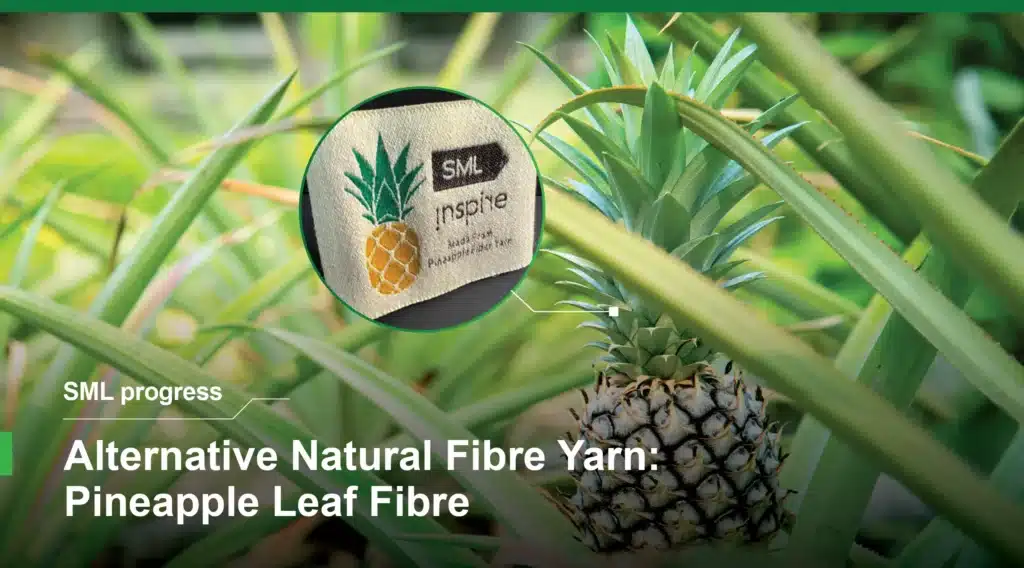
As regulatory scrutiny around material claims intensifies, the materials brands select for product components become compliance decisions – not just design ones. SML has developed a Pineapple Leaf fibre (PALF) yarn for woven label applications that meets this moment.
PALF is derived from pineapple leaves generated after fruit harvesting and processed for textile use. It is not a concept material – it is production-ready. With appropriate fibre treatment, PALF yarn delivers a soft handfeel alongside durable woven structures, mechanical resistance, and stable label performance. It is suitable for controlled, scalable manufacturing and can be applied to apparel and accessory labels where both functional requirements and responsible material sourcing are priorities.
What makes PALF strategically relevant now is alignment with the regulatory direction outlined in this edition. As brands face increasing expectations around material transparency, fibre traceability, and verifiable sourcing claims, PALF offers a fibre with a clean, traceable origin rooted in agricultural circularity. It supports material diversification without compromising the performance standards woven labels must meet.
Interested in PALF yarn for your woven label programme? Contact us
Stay ahead of shifting regulations. Subscribe to our newsletter for the latest updates and strategies to future-proof your business.

Ready to talk?
Discover tailored solutions and lead the way in sustainability.