Sustainability Insights #27

Europe’s packaging rules are no longer just tightening – they’re being rewritten. With Germany’s VerpackDG replacing the VerpackG in August 2026 and the PPWR now shaping national law directly, brands face new producer obligations, higher recycling targets, and stricter eco-design requirements. Discover what’s changed, who’s affected, and how SML is helping brands stay ahead with compliant, plant-based alternatives.
Read the full article below or Contact our experts today to future-proof your packaging strategy.
On 11 February 2026, the German Federal Cabinet adopted the new Packaging Implementation Act (VerpackDG), which will fully replace the existing Packaging Act (VerpackG) when it enters into force on 12 August 2026.
This is more than a revision – it’s a comprehensive reset. The EU Packaging and Packaging Waste Regulation (PPWR) will apply directly across all Member States, which means national laws must be updated to avoid contradictions. Germany’s VerpackDG acts as the national implementation bridge: retaining proven parts of its system (like the LUCID register, ZSVR oversight, and dual systems) while ensuring full compatibility with the PPWR’s stricter lifecycle-based requirements.
What’s New in the VerpackDG:
| Area | What’s Changing |
|---|---|
| System participation & authorisation | Obligated parties – including systems, EPR schemes, and non-represented producers – must now allocate a portion of their budgets toward reducing packaging waste, such as strengthening reusable and refill systems and supporting awareness campaigns. |
| Higher recycling targets | From 1 January 2028, plastic packaging must reach a 75% recycling rate, of which 70% must be achieved through mechanical recycling. The remaining share may be fulfilled through other recognised recycling processes, subject to applicable EU and national calculation rules. These replace previous recovery-based targets. |
| Mandatory waste-prevention and reuse funding | Under the VerpackDG, obligated systems and EPR organisations must allocate a binding share of their budgets to packaging waste‑prevention measures, including reuse and refill infrastructure and consumer awareness initiatives. This requirement is intended to shift financial responsibility toward single‑use packaging systems and support upstream waste reduction. |
| Eco-design enforcement | While the eco-design requirements themselves come from the PPWR, the VerpackDG ensures they can be implemented and enforced nationally. Packaging must comply with harmonised EU recyclability criteria – including material composition, separability, and compatibility with recognised recycling systems. Minimum recycled-content rules for certain plastic packaging will also phase in under the PPWR, with the VerpackDG providing the national enforcement framework. |
For businesses, this means reviewing material mixes, adhesives, and component separability more rigorously, anticipating a more standardised EU-wide recyclability scoring system under the PPWR and the growing demand for sustainable packaging.
Already thinking about your material transition? Explore SML’s sustainable packaging solutions →
Key takeaway:
Germany’s new VerpackDG prepares the country for the PPWR era by introducing mandatory producer authorisations, new waste-prevention funding, and higher plastic-recycling targets – while ensuring EU-wide eco-design and recyclability rules can be enforced nationally.
Sources: Packaging Europe; BMUV Press Release
PPWR Update: Pallet Wrappings and Straps Exempt from 100% Reuse Requirement
On 25 February 2026, the European Commission formally adopted its first Delegated Act under the PPWR, entering into force 20 days after its publication in the Official Journal.
- What changed: Pallet wrappings and straps used for stabilization and protection of products during transport are now exempt from the PPWR’s original 100% reuse requirement. An EU feasibility study found that enforcing full reuse would impose disproportionate adaptation costs on operators.
- What still applies: These items remain part of the broader 40% reusable transport packaging target that applies from 1 January 2030.
- Why it matters beyond pallet wrap: This is the first time the Commission has used a delegated act to adjust a PPWR target – signaling that the regulation will be fine-tuned over time based on feasibility, not rewritten. The ambition stays; the implementation adapts. Brands should watch for more delegated acts across other packaging categories.
Key takeaway:
Even with the exemption from the 100% reuse rule, companies must still meet the PPWR’s 40% reusable transport and sales packaging target by 2030, with pallet wrappings and straps still counted toward that overall requirement.
Source: European Commission — Environment

Under the new VerpackDG, the definition of “producer” is now fully aligned with the PPWR’s Article 3-replacing the previously used German‑specific terminology. This harmonized definition determines who is responsible for registration, EPR scheme participation, and reporting obligations.
This matters because, under Article 3 of the PPWR, producer responsibility is linked to the company that first places packaging or packaged products on the market in a Member State. In practice in Germany, this is applied by identifying the operator that effectively brings the packaging into the supply chain, where it enters the market and will later be managed as waste. Depending on the supply‑chain setup, this could be the manufacturer, the distributor, or the importer.
How the producer is determined depends on the packaging type:
| Packaging Type | When Is It Considered “Complete”? | Supply Chain Begins With… |
|---|---|---|
| Transport, service & primary production packaging already in final form (e.g. rigid packaging) | When the empty packaging is complete | The complete, empty packaging |
| Transport, service & primary production packaging that takes final form when filled (e.g. flexible packaging) | When the packaging is filled | The filling of the packaging |
| Sales & grouped packaging | When the packaging is filled | The packaged product |
The following role descriptions reflect how the PPWR’s Article 3 definitions are applied in Germany, based on guidance from the Zentrale Stelle Verpackungsregister (ZSVR):
- Producer: The party subject to organisational and financial EPR obligations.
- Manufacturer: The party responsible for ensuring the packaging unit complies with the PPWR (there is only one manufacturer per supply chain). Any company that manufactures packaging or packaged products — or has them manufactured — under their own name or trademark is considered the manufacturer.
- Importer: A company based in Germany that brings complete packaging or packaged products from a third country into Germany. (Goods from another EU Member State are not classified as “imports” under the PPWR.)
- Distributor: A company based in Germany that offers complete packaging or packaged products originating from another EU Member State on the German market.
Review each packaging unit you place on the market and check who qualifies as the “producer” or “manufacturer” under the PPWR’s Article 3 definitions. These EU-harmonised criteria may assign responsibility differently from the old German VerpackG rules – meaning your obligations could have changed even if your supply chain hasn’t.
Need packaging that’s designed for compliance from the start? See how SML supports brands through the transition →
Source: Zentrale Stelle Verpackungsregister — Producer Definition
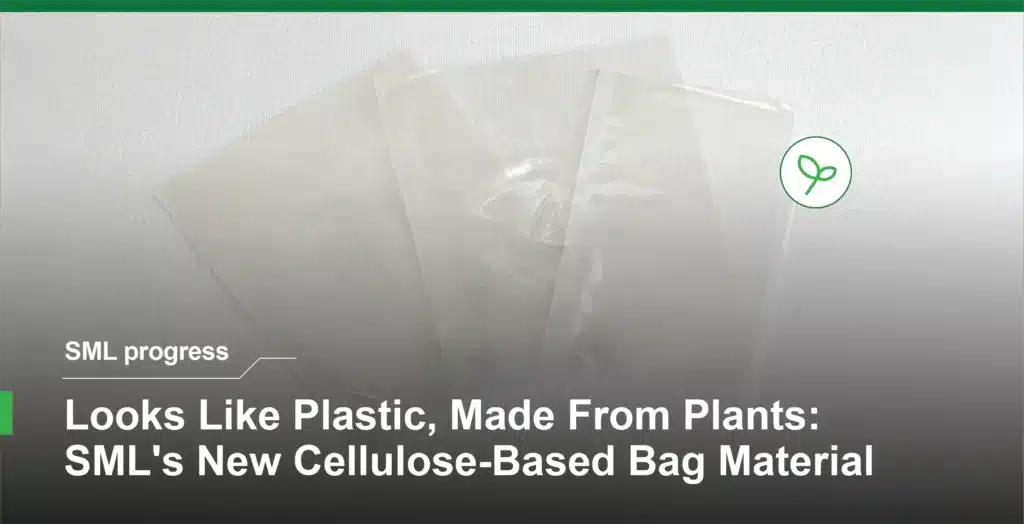
SML introduces a new Transparent Cellulose Bag material that visually resembles clear plastic film but is made from cellulose derived from plant-based sources. This material offers a clean, modern, semi-transparent appearance while helping brands reduce reliance on conventional fossil-based plastic bags.
| Conventional Plastic Film | Conventional Plastic Film | |
|---|---|---|
| Source material | Fossil-based | Plant-derived cellulose |
| Appearance | Clear, premium | Clear, premium – visually comparable |
| Printability | High | High |
| Look & feel | Standard plastic | Modern, semi-transparent, premium |
With good clarity, printability, and a premium look and feel, the cellulose-based bag provides an appealing alternative for brands seeking material transition options without compromising presentation quality.
Interested in the Transparent Cellulose-Based Bag? We’d love to tell you more. Contact us →

Ready to talk?
Discover tailored solutions and lead the way in sustainability.