EUDR Updates: What the New Product Scope Means for Packaging and Labels

The European Commission’s July 2026 measures refine the product scope of the EU Deforestation Regulation and update its Information System. The changes provide greater clarity on how the EUDR applies to packaging, labels and information materials, while introducing targeted exclusions and simplified digital reporting.
Need help understanding what the EUDR may mean for your labels, packaging or supply chain? Contact SML to discuss your product and compliance requirements.
The European Commission adopted two measures on 13 July 2026 to support implementation of the EU Deforestation Regulation (EUDR): a Delegated Act updates and simplifies the product list covered by the Regulation and an Implementing Act updating its Information System.
For businesses, the practical message is straightforward: some products have been removed from scope, others have been added, and targeted exclusions provide further clarity on how the EUDR applies to packaging, labels and other information materials. (environment.ec.europa.eu)
The key developments are:
- Several cattle, rubber, soy and seating products have been removed from scope.
- Soluble coffee, certain palm oil derivatives and frozen cattle tongues have been added.
- Newly added products will become subject to the EUDR from 30 December 2027.
- Targeted exclusions clarify the treatment of certain packaging, waste, used and second-hand products.
- Certain marketing and information materials accompanying another product are excluded.
- The EUDR Information System now supports simplified declarations for qualifying micro and small primary operators and updated API specifications.
Together, the changes are intended to provide greater legal certainty and make EUDR implementation more manageable for businesses, authorities and trading partners. (environment.ec.europa.eu)
What is the EU Deforestation Regulation?
The EUDR aims to ensure that specified commodities and derived products placed on the EU market or exported from it do not contribute to deforestation or forest degradation.
It covers seven commodities:
- Cattle
- Cocoa
- Coffee
- Palm oil
- Rubber
- Soy
- Wood
Operators placing relevant products on the EU market or exporting them must demonstrate that the products are deforestation-free and have been produced in accordance with the relevant legislation of the country of production. (environment.ec.europa.eu)
What changed in the EUDR product scope?
The Delegated Act adopted on 13 July 2026 updates Annex I of the EUDR following stakeholder consultation and public feedback.
It does not change the seven commodities covered by the Regulation. Instead, it changes the list of products derived from those commodities that fall within scope. (environment.ec.europa.eu)
Products removed from scope
The changes remove or narrow the coverage of several product categories, including:
- Cattle hides, skins and leather
- Re-treaded tyres
- Soybeans for sowing
- Certain articles of vulcanised rubber
- Conveyor and transmission belts
- Aircraft and motor-vehicle seats
Products added to scope
The revised Annex I adds:
- Soluble coffee
- Certain palm oil derivatives
- Frozen cattle tongues
To provide businesses with more time to prepare, products newly added through the Delegated Act will become subject to the Regulation from 30 December 2027. (environment.ec.europa.eu)
How does the update affect packaging?
The Delegated Act provides additional clarification for wooden packaging under CN 4415 and paper and paperboard products under Chapter 48.
The central question is not simply what the packaging is made from. Businesses must also consider how it is presented, supplied and used.
Certain packaging used exclusively to support, protect or carry another product may fall outside the EUDR scope, depending on how it is supplied and placed on the market. This may include certain qualifying single-use and reusable packaging supplied with another product.
By contrast, packaging placed on the EU market or exported as a product in its own right may remain within scope where the relevant CN code in Annex I is covered by the Regulation.
Summary of the clarified exclusions
| Product scenario | Wooden packaging?CN 4415 | Paper and paperboard?Chapter 48 |
|---|---|---|
| Used and second-hand products | Excluded | Excluded |
| Single-use packaging used exclusively to support, protect or carry another product | Excluded | Excluded |
| Reusable packaging used exclusively to support, protect or carry another product | Excluded | Excluded |
| Recovered paper and products made from recovered materials | ? | Excluded |
| Marketing and information materials accompanying another product | ? | Excluded |
The Delegated Act also introduces targeted exemptions for other categories, including certain waste products and samples or products used for analysis, examination and testing. (environment.ec.europa.eu)
Key takeaway:
Packaging should not be assessed by material alone. Its customs classification, purpose and route to market can all affect whether it falls within EUDR scope.
What changed in the EUDR Information System?
Alongside the product-scope update, the Commission adopted an Implementing Act establishing updated technical rules for the EUDR Information System.
The updated system includes:
- Simplified declarations for qualifying micro and small primary operators
- Updated technical specifications for automated application programming interfaces
- Contingency arrangements
- Measures intended to simplify use of the system and reduce incorrect, unnecessary or duplicate data
These improvements are intended to support more efficient reporting and system integration, particularly for businesses using automated compliance processes. (environment.ec.europa.eu)
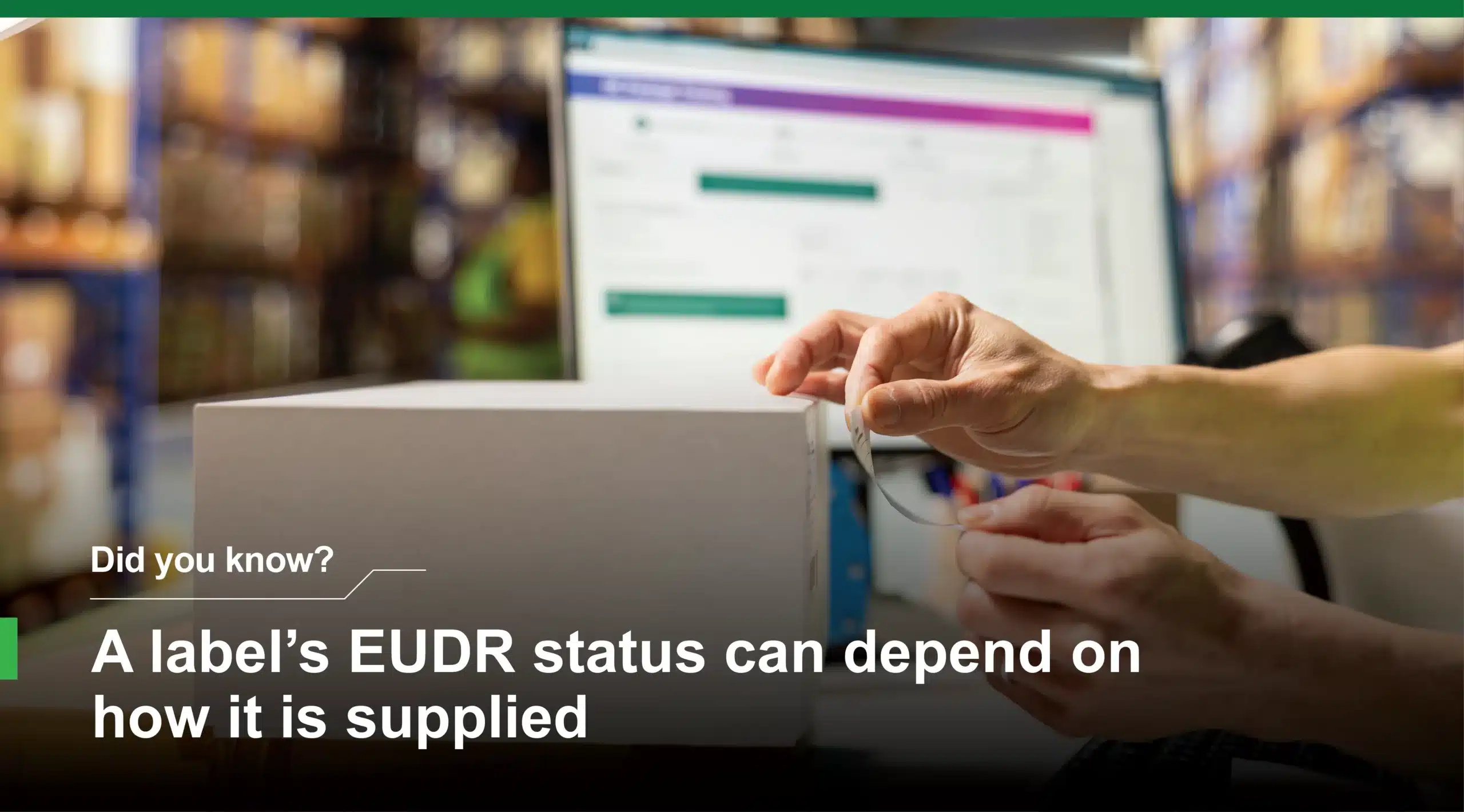
A label, tag, booklet or other paper information material is not automatically inside or outside EUDR scope simply because it is made from paper.
Under the July 2026 update, certain marketing and information materials are excluded when they accompany another product or are supplied free of charge for marketing or information purposes.
For example, a product-information booklet included inside a garment box may qualify for the exclusion.
However, certain labels and tags placed on the market or exported as standalone products may remain subject to EUDR scope assessment.
Three factors can determine the outcome
1. Product classification
What is the applicable Harmonized System or Combined Nomenclature code?
HS and CN classification remains the starting point for determining whether a product is listed in Annex I.
2. Product function
Does the label or information material accompany and provide information about another product, or is it being supplied as an independent commercial product?
3. Route to market
Is the item:
- Included with another product?
- Supplied free of charge for an eligible marketing or information purpose?
- Sold or exported independently?
The same type of label may therefore receive a different EUDR assessment depending on its supply-chain scenario.
When will the EUDR apply?
The main EUDR application dates are:
- 30 December 2026: Large and medium-sized operators, and micro and small enterprises previously covered by the EU Timber Regulation
- 30 June 2027: Other micro and small operators
- 30 December 2027: Products newly added through the July 2026 Delegated Act
The Delegated Act has been adopted and is currently undergoing scrutiny by the European Parliament and the Council. Businesses should continue monitoring its legal status and confirm the final applicable text before relying on a new exclusion. (environment.ec.europa.eu)
What should businesses do now?
Businesses handling wood-, paper- or other commodity-derived products should use the remaining preparation period to review their product portfolios and compliance processes.
Recommended actions
- Review products against the revised Annex I.
Identify products that have been added, removed or affected by a new clarification or exclusion. - Confirm HS and CN classifications.
Check that customs codes are accurate and appropriately documented. - Distinguish standalone products from accompanying materials.
Determine whether packaging, labels, tags or information materials are sold independently or supplied with another product. - Assess both function and route to market.
Do not assume that all products made from the same material will receive the same scope determination. - Document the basis for each decision.
Maintain evidence explaining why a product has been assessed as in scope or excluded. - Update supply-chain data requirements.
Review the information requested from suppliers and customers where product classifications or obligations have changed. - Prepare digital reporting processes.
Test workflows, declarations and API connections to the EUDR Information System. - Monitor the Regulations implementation.
Track the Delegated Acts legal status, system updates and further European Commission guidance.
The revised scope introduces further clarification regarding product coverage and exclusions. However, businesses should still evaluate products on a case-by-case basis. Businesses should seek appropriate customs or legal advice when classification or applicability remains uncertain.

Regulatory readiness is one part of building more responsible supply chains. Improving the environmental performance of our Bangladesh site increased its renewable energy use in the first half (H1) of 2026 after commissioning a new 160 kWp rooftop solar photovoltaic (PV) system in January. This addition significantly expanded the site’s renewable electricity capacity.
With both the new and existing solar PV systems in place, the site used more than 151 MWh of renewable electricity from January to June. This pushed the share of renewables in the overall electricity supply from 3.3% in the first half of 2025 to 7.1% in the same period of 2026- helping lower reliance on grid and diesel-generated power.
Building on this progress, renewable energy accounted for approximately 6% of total electricity consumption across our Bangladesh manufacturing sites in H1 2026, supporting our progress toward a lower-carbon future.
Looking ahead, SML is assessing further opportunities to increase renewable energy use, including the potential expansion of rooftop solar PV capacity and the procurement of renewable energy certificates. In parallel, the site is progressing a range of energy efficiency initiatives identified through its energy audit to reduce energy consumption and improve operational performance, supporting the company’s long-term sustainability ambitions.
Frequently Asked Questions
Does the EUDR cover packaging?
It can. Packaging placed on the EU market or exported as a standalone product may be covered if its classification appears in Annex I. Qualifying packaging used exclusively to support, protect or carry another product is generally excluded.
Are paper labels covered by the EUDR?
Paper labels and other qualifying information materials that accompany another product?or are supplied free of charge for an eligible marketing or information purpose?are generally excluded. Labels sold or exported independently normally require a standard EUDR scope assessment.
Can two similar labels receive different EUDR assessments?
Yes. The outcome may differ depending on each label?s customs classification, function and route to market. For example, a label supplied with another product may be treated differently from the same type of label sold independently.
When do the main EUDR requirements begin to apply?
The Regulation is scheduled to apply from 30 December 2026 for large and medium-sized operators and micro and small operators already covered by the EU Timber Regulation. It is scheduled to apply from 30 June 2027 for other micro and small operators. (environment.ec.europa.eu)
When do newly added products become subject to the EUDR?
Products added through the Delegated Act adopted in July 2026 are scheduled to become subject to the EUDR from 30 December 2027. (environment.ec.europa.eu)
What is the EUDR Information System?
The EUDR Information System is the European Commission?s digital platform for submitting and managing due diligence statements and simplified declarations required under the Regulation.
This article provides general information and should not be treated as legal, regulatory or customs-classification advice.