Sustainability Insights #29

The European Commission’s PPWR guidance, issued in March 2026, resolves key uncertainties about how packaging obligations apply before the full suite of EU technical rules is in place. It clarifies what recyclability compliance looks like right now, who bears regulatory responsibility, and when harmonized labelling requirements will take effect. In parallel, SML Group’s SBTi verified net zero target confirms the same principle the guidance reinforces: stating an intention is no longer the standard. Demonstrating verified, evidence-backed progress is.
Read the full article below or Contact our experts today to ensure your labelling and packaging strategy is prepared.
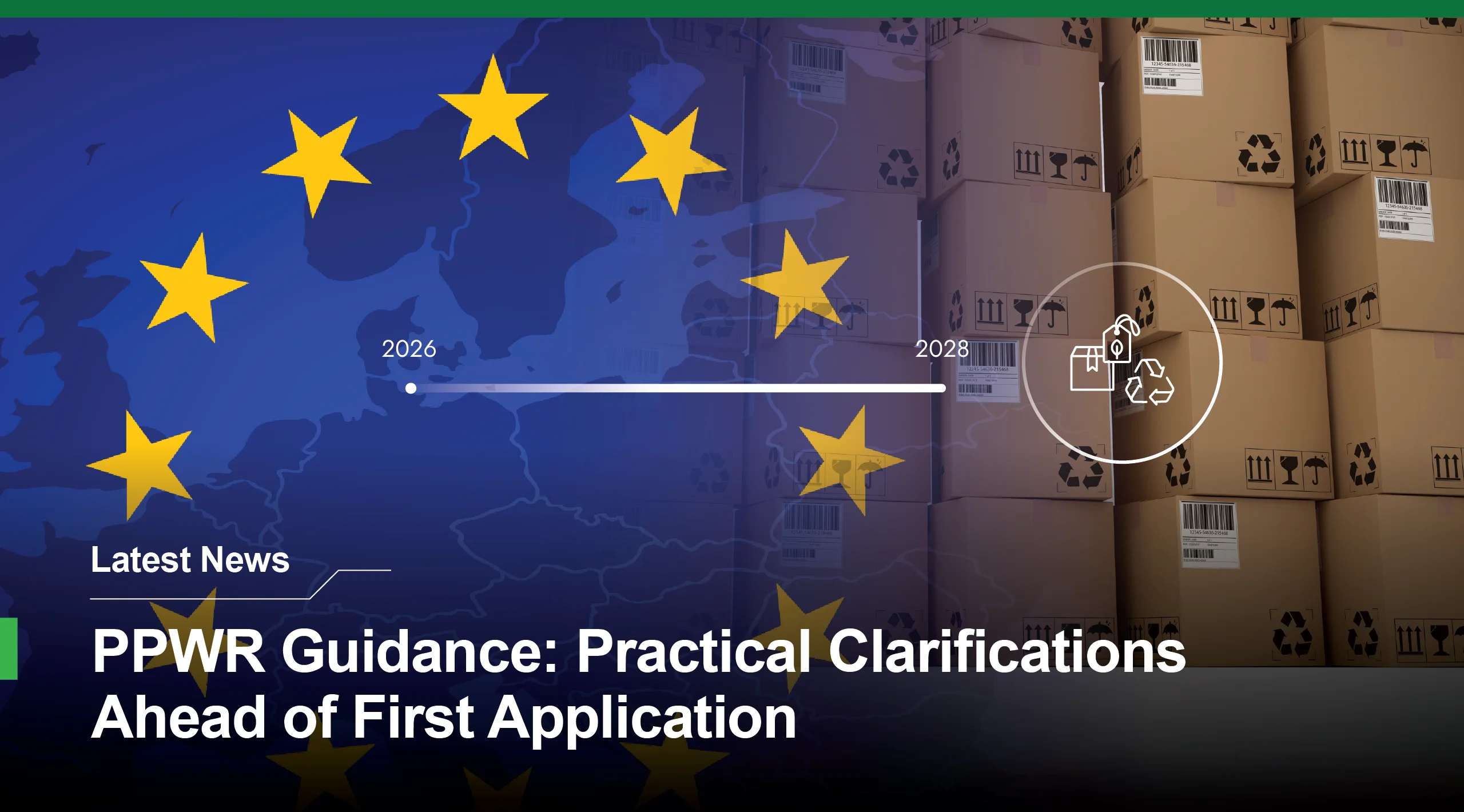
Regulation of this scale rarely arrives in a single, fully formed moment. It arrives in phases, with obligations becoming active at different points depending on whether the underlying technical acts that define them have been finalised. For the past year, that phased structure has left businesses navigating genuine uncertainty about what PPWR compliance actually requires of them right now.
In March 2026, the European Commission issued its guidance on Regulation (EU) 2025/40 to address that uncertainty directly, providing a consistent and pragmatic baseline for both businesses and authorities before detailed EU level technical rules are fully in place. Three areas of clarification are particularly significant for packaging and brand professionals.
1. Managing Regulatory Gaps Before EU Technical Acts Are in Force
Article 6(1) of PPWR requires all packaging placed on the market be recyclable from August 2026. However, the detailed PPWR-specific assessment methodology has not yet been established. The Commission clarifies that, during this transitional period, compliance continues to be assessed under existing frameworks until the relevant delegated acts enter into force. The Commission resolves this gap clearly:
- PPWR specific recyclability criteria apply only once the relevant delegated acts enter into force
- Until then, compliance continues under the existing Packaging and Packaging Waste Directive and EN 13430
- PPWR implementation is intentionally phased, with obligations becoming active at different points depending on the availability of EU technical rules and implementing acts
- This phased structure is designed to prevent regulatory gaps and inconsistent national enforcement across Member States
Brands are not operating in a compliance vacuum during the transition. But they do need to understand clearly which framework governs them at which point, and plan accordingly.
2. Clarifying Who Is the “Manufacturer” Under PPWR
The guidance revisits two definitions that have generated considerable debate since the Regulation’s adoption. For brand owners, the clarification on “manufacturer” carries direct compliance implications.
| Term | Definition Under PPWR | Key Implication |
|---|---|---|
| Manufacturer | Manufacturers of packaging or a packaged product. According to the above, it is not the person who manufactures the packaging but the person who ‘orders and decides on the design specifications for packaging’. Exemption for brand owners when they are micro-enterprises, and the person that supplies the packaging is located in the same Member State. | Brand owners who set packaging specifications carry this responsibility, not the supplier |
| Producer | Any manufacturer, importer or distributor who makes packaging or packaged products available for the first time in the Member State where it is present or directly to end users in another Member State. | Covers a broad range of supply chain actors |
Exemption: Brand owners that qualify as micro enterprises are relieved of the manufacturer obligation, provided the party supplying their packaging is located in the same Member State.
Source: p.12, ANNEX to the Communication to the Commission, Approval of the draft Commission Notice on the Guidance document for Regulation (EU) 2025/40
3. Harmonised Packaging Labelling
The guidance confirms that PPWR will fully harmonise packaging labelling at EU level. Once the system applies, Member States may no longer maintain their own mandatory national labelling schemes, with a limited exception for deposit and return systems.
| Label Type | Status Under PPWR | Applies From |
|---|---|---|
| Waste sorting labels | Mandatory | 12 August 2028, or 24 months after the relevant implementing acts enter into force, whichever is later |
| Reusable packaging labels | Mandatory | Same timeline |
| Recycled content labels | Voluntary; if used, must comply with EU harmonised rules on calculation and communication once established | Same timeline |
| Compostability labels | Mandatory where compostability is required; otherwise voluntary, but must follow EU harmonised rules if used | Same timeline |
For brands currently managing different labelling requirements across European markets, this harmonisation resolves the double labelling concern that has complicated planning. The transition window is defined and sufficient for preparation. What it is not is a reason to defer decisions about labelling strategy.
Key takeaway:
The Commission’s PPWR guidance clarifies how the Regulation should be applied during the transition period, addressing common uncertainties about timing, national flexibility, and compliance expectations. For brands that have treated packaging sustainability claims as a communications decision rather than a compliance one, that window for easy course correction is narrowing. Explore SML’s labelling and packaging solutions to ensure your strategy is built for the framework ahead.
Source: Guidance document on Packaging and Packaging Waste Regulation (PPWR)
Alongside its March 2026 guidance, the European Commission published a dedicated set of Frequently Asked Questions to address the wide range of practical issues raised by stakeholders since the Regulation’s adoption.
The FAQs cover a range of practical topics, including but not limited to:
- Recyclability requirements and how they apply during the transition
- Transitional arrangements and which rules currently govern compliance
- Roles and responsibilities across the supply chain
- Application timelines for specific obligations
The Commission will update these FAQs as needed as implementation progresses and new questions arise. For businesses working through specific compliance scenarios, the FAQs should be used alongside the guidance document and do not replace or amend the legal requirements set out in the Regulation.
Source: Packaging and Packaging Waste Regulation (PPWR) – Publications Office of the EU, European Commission

The expectation that the PPWR guidance reinforces for packaging claims, that stated intentions must be backed by independently verified evidence, applies equally to how companies account for their own environmental commitments. Claiming a net zero ambition and having that ambition verified against a defined scientific standard are different things entirely.
In 2025, the Science Based Targets initiative validated SML Group’s science based net zero target, confirming alignment with the SBTi Net Zero Standard. The commitments are specific and time bound:
Overall Net-Zero Target
SML Group is committed to achieving net-zero greenhouse gas emissions across its value chain by 2050, in line with the Science Based Targets initiative (SBTi) Net-Zero Standard.
| Timeframe | Emissions Scope | Reduction Target |
|---|---|---|
| By 2030 | Scope 1 and Scope 2 | 42% absolute reduction from a 2021 base year |
| By 2030 | Scope 3 (purchased goods and services, capital goods, business travel, employee commuting) | 42% absolute reduction from a 2021 base year |
| By 2050 | Scopes 1, 2, and Scope 3 (purchased goods and services, capital goods, business travel, employee commuting) | 90% absolute reduction |
SML Group is implementing and strengthening decarbonization initiatives across its operations and value chain, working collaboratively with suppliers and partners to deliver against these targets in a way that is measurable and externally accountable.
The SBTi verification is not a milestone to mark and move past. It is the beginning of a period in which progress must be demonstrated, not just described. That standard, like the one the PPWR guidance establishes for packaging claims, reflects the direction the industry is heading regardless of whether individual businesses are ready for it.
Stay ahead of shifting regulations. Subscribe to Sustainability Insights for monthly updates built for packaging and sustainability professionals.