California SB 54 Packaging EPR: What Brands Need to Know

California’s SB 54 packaging EPR framework is advancing through two important 2026 developments: the Circular Action Alliance submitted its California Producer Responsibility Plan on 13 October 2026, and CalRecycle published an updated Source Reduction Baseline Report on 2 November 2026. The proposed framework signals increasing attention to source reduction, recyclability, and packaging design considerations.
Brands may consider evaluating packaging weight, material selection, packaging complexity, and recyclability performance as California’s packaging EPR framework continues to develop.
Need help reviewing packaging and labelling readiness? Contact SML to discuss how packaging, labelling, item-level RFID, RFID labels, and product identification solutions can support evolving sustainability and packaging requirements.
California SB 54 packaging EPR is moving from framework design toward practical implementation. The law creates producer responsibility requirements for covered single-use packaging and plastic food service ware, with source reduction, recycling, fee-setting, and eco-modulation obligations expected to shape how brands evaluate packaging design, recyclability, and material use.

What changed in California SB 54 in 2026?
California SB 54 moved closer to implementation in 2026 because the Circular Action Alliance submitted its Producer Responsibility Plan and CalRecycle updated the plastic source reduction baseline.
In October 2026, California’s producer responsibility organisation for SB 54 submitted the Circular Action Alliance California Producer Responsibility Plan to CalRecycle. The plan outlines how California’s packaging EPR law may be implemented in the coming years, including proposed fee-setting mechanisms, eco-modulation concepts, recycling system investments, and packaging design considerations.
In November 2026, CalRecycle updated its Source Reduction Baseline Report using producer-reported data. The updated baseline identifies approximately 1.03 million tons of plastic covered material and 222 billion plastic components, which CalRecycle will use to measure progress toward statewide source reduction targets.
For producers, packaging data and material information are becoming increasingly important as SB 54 implementation progresses.
What is California SB 54?
California SB 54, also known as the Plastic Pollution Prevention and Packaging Producer Responsibility Act, establishes an Extended Producer Responsibility framework for covered single-use packaging and plastic food service ware.
The law is designed to shift more responsibility for packaging waste management from public systems to producers that place covered materials on the California market. CalRecycle SB 54 packaging EPR guidance describes SB 54 as a statewide EPR programme for packaging and single-use plastic food service ware products across every sector of the economy.
SB 54 includes requirements related to:
- Source reduction
- Recycling performance
- Producer-funded programme activities
- Covered material reporting
- Eco-modulated fees
- Recycling and reuse system investments
- Packaging design considerations
SB 54 creates a stronger connection between packaging decisions and future producer obligations.
What are California’s SB 54 source reduction targets?
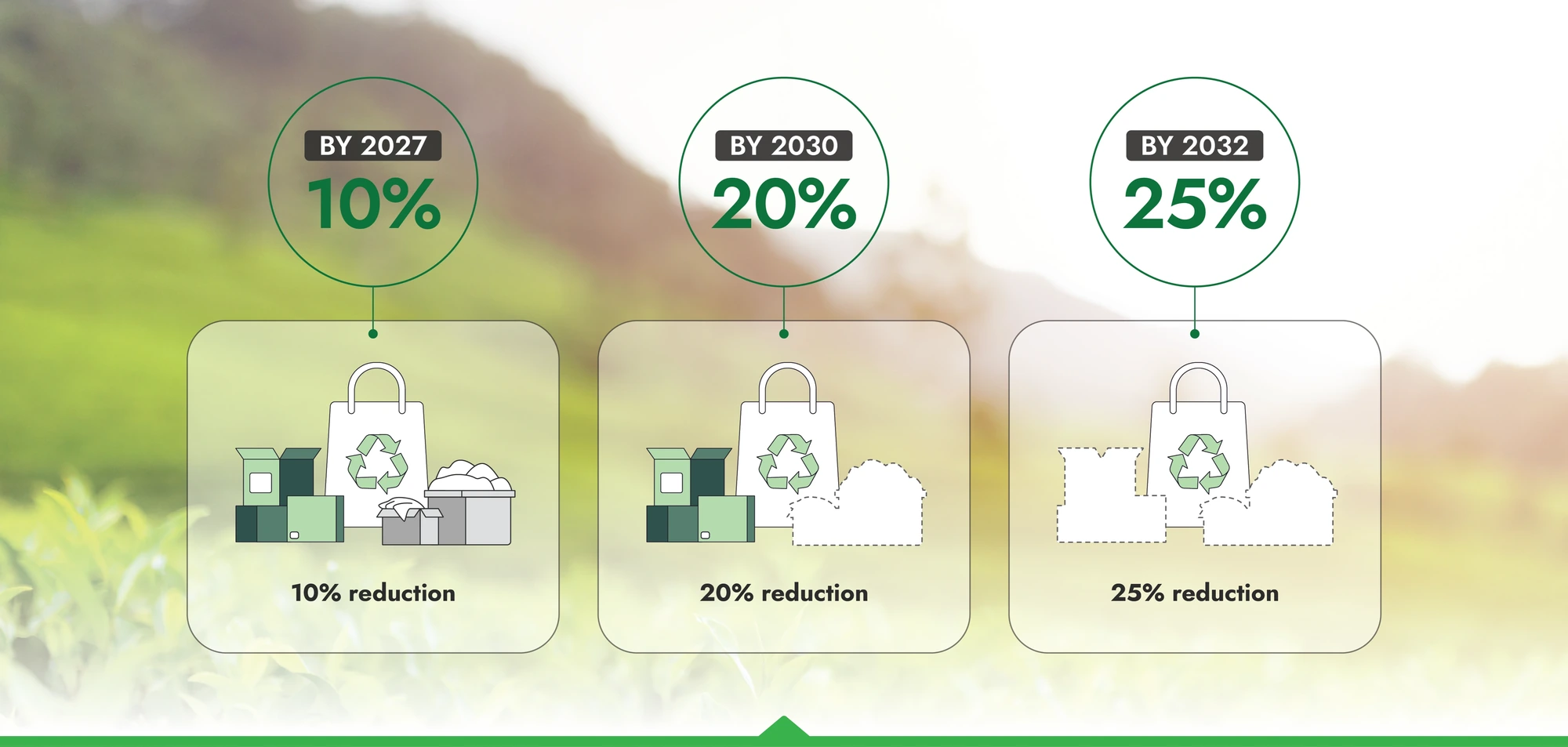
California’s SB 54 source reduction targets require a 25% reduction in single-use plastic packaging and plastic food service ware by 2032, with interim targets of 10% by 2027 and 20% by 2030.
The updated CalRecycle source reduction guidance will be used to measure progress against these statutory targets. The November 2026 update is based on producer-reported data rather than earlier modeled estimates.
| Target year | Source reduction target |
|---|---|
| 2027 | 10% |
| 2030 | 20% |
| 2032 | 25% |
Source reduction means reducing the amount of covered plastic material entering the market. Examples may include lightweighting, eliminating unnecessary packaging components, switching materials, and implementing reuse or refill systems, and other measures that reduce the amount of plastic covered material supplied to the market. Increasing recycled content alone is not considered source reduction under SB 54.
For producers, source reduction is likely to become an important packaging design and reporting consideration. Under SB 54, statutory source reduction targets are achieved collectively through the Producer Responsibility Organisation’s approved plan.
How may SB 54 fees be calculated?
California SB 54 fees are expected to be calculated across Covered Material Categories, with proposed adjustments based on material type, recyclability, collection and management costs, commodity value, and eco-modulation factors.
The Circular Action Alliance’s proposed 2027 fee framework introduces the first phase of eco-modulation under California’s SB 54 programme. The plan includes two initial approaches.
| Eco-modulation approach | Purpose |
|---|---|
| Source reduction incentives | Encourage reduced plastic use, post-consumer recycled content, and reuse and refill systems. |
| Recycling performance incentives | Encourage higher recycling performance and discourage categories designated as non-recyclable or non-compostable. |
The recycling-performance mechanism uses a passive eco-modulation approach. That means bonuses and maluses may be applied at the Covered Material Category level rather than through individual producer applications.
Under the Producer Responsibility Plan submitted by Circular Action Alliance, Covered Material Categories with recycling rates of at least 30% may receive a 5% bonus on base fees, while categories designated as non-recyclable and non-compostable may be subject to a 5% malus. These provisions remain subject to CalRecycle review and approval.
The proposed framework is expected to make packaging characteristics and recyclability performance more visible in future fee outcomes.

How will eco-modulation expand from 2029?
Circular Action Alliance does not currently propose additional eco-modulation factors for 2028 and instead expects to use the initial implementation period to evaluate programme performance and refine methodologies.
Beginning with the proposed 2029 programme year fees, CAA intends to introduce additional active eco-modulation measures. These measures may encourage packaging designs that improve recyclability and discourage packaging features that create recycling challenges.
Unlike passive eco-modulation, active eco-modulation may require producer-specific reporting, self-attestation, or supporting documentation.
The plan specifically references packaging features such as:
- Labels
- Adhesives
- Coatings
- Inks
- Sleeves
- Valves
- Nozzles
These features may improve or hinder recycling outcomes depending on their design and material compatibility.
For producers, SB 54 may require a more detailed review of the full packaging system, including packaging components and ancillary elements, rather than only the primary packaging material.
What packaging may be relevant for apparel and footwear brands?
For apparel and footwear brands, SB 54 may be relevant to packaging used for containment, protection, handling, delivery, or presentation of products.
Relevant packaging may include:
- Garment polybags
- Product boxes
- Shoe boxes
- E-commerce mailers
- Protective films
- Packaging labels
- Sleeves and wraps
- Inserts and support materials
- Other single-use packaging components
Depending on the specific supply chain and packaging configuration, relevant packaging may also extend to certain secondary or transport packaging associated with products placed on the California market. Applicability should be assessed based on the specific design, material, function, and use case of each item.
Apparel and footwear brands should not evaluate only the finished product. Packaging components, labels, adhesives, coatings, and other supporting materials may become increasingly important under recyclability-focused EPR frameworks.
Who is responsible for SB 54 producer obligations?
SB 54 uses a producer responsibility framework to determine which entity may be responsible for compliance and associated programme obligations.
Producer responsibility depends on the commercial structure, brand ownership, licensing arrangements, import pathway, and market placement route.
| Typical scenario | Producer typically responsible under SB 54 |
|---|---|
| Branded apparel, footwear, or consumer goods sold under a brand or trademark | Brand owner, trademark owner, or entity licensing the brand |
| Products sold under a retailer-owned private label brand | Retailer that owns the brand or trademark |
| Licensed brands | Brand owner or exclusive licensee, depending on the arrangement |
| Unbranded products imported, sold, or distributed into California where no upstream producer is identified under the statutory hierarchy | Importer, distributor, or seller placing the product on the California market |
This table is illustrative only. Producer status should be reviewed against the final applicable SB 54 requirements and the specific commercial arrangement.
SB 54 makes responsibility mapping an important part of packaging compliance planning.
Why are mono-material packaging structures receiving attention?
Mono-material packaging structures are receiving attention in broader packaging sustainability discussions because they may simplify collection, sorting, and recycling in some applications.
A mono-material structure can sometimes simplify sorting and recycling compared with complex multi-material packaging. However, mono-material design is not automatically compliant or recyclable in every context. Performance depends on the material, format, additives, labels, adhesives, inks, and local recycling system compatibility.
SB 54’s proposed fee framework signals that packaging design details may increasingly affect cost, compliance, and reporting outcomes.
What should brands do now?
Brands should begin by creating a packaging inventory that maps materials, formats, weights, components, recyclability attributes, and California market placement data.
A practical SB 54 readiness review should include:
- Map covered packaging materials — Identify packaging and plastic food service ware that may fall within SB 54 scope.
- Confirm Covered Material Categories — Classify packaging by material type and format.
- Track packaging weights and component counts — Prepare data that may support reporting, fee calculation, and source reduction planning.
- Review recyclability performance — Assess whether materials align with collection, sorting, and recycling systems.
- Evaluate packaging complexity — Review labels, adhesives, coatings, inks, sleeves, valves, nozzles, and multi-material components.
- Assess source reduction opportunities — Consider lightweighting, component elimination, reuse, refill, and packaging optimisation opportunities.
- Map producer responsibility — Identify the entity responsible for each brand, private label, licensed product, or imported product.
- Prepare supporting documentation — Maintain evidence for packaging material choices, recyclability claims, and design-for-recycling decisions.
Packaging EPR readiness increasingly depends on accurate packaging data.
How can SML support packaging and labelling readiness?
SML supports brands with packaging and labelling solutions that can help simplify packaging structures, improve material efficiency, and support design-for-recycling objectives.
California’s SB 54 framework is sending a clear market signal: packaging that is lighter, less complex, and designed for recyclability may become increasingly important as producers respond to evolving EPR requirements.
SML works with customers on packaging and trim development, including solutions that may support packaging efficiency, product identification, labelling, item-level RFID solutions, RFID labels, and traceability and circularity solutions across global markets.
SML’s support may be relevant where brands are reviewing:
- Packaging labels and trims
- Material efficiency
- Packaging simplification
- Design-for-recycling objectives
- Product identification
- Traceability and product data, including Digital Product Passport solutions
- Global packaging requirement readiness
SML does not replace legal or regulatory review. SML can help brands strengthen the packaging, labelling, and product information foundations that support evolving sustainability requirements.

Key takeaways:
- California SB 54 establishes a packaging EPR framework for covered single-use packaging and plastic food service ware.
- Circular Action Alliance submitted its California Producer Responsibility Plan to CalRecycle on 13 October 2026.
- CalRecycle updated the SB 54 source reduction baseline on 2 November 2026 using producer-reported data.
- California’s statutory source-reduction targets for plastic covered material are 10% by 2027, 20% by 2030, and 25% by 2032.
- The updated baseline is approximately 1.03 million tons of plastic covered material and 222 billion plastic components.
- Proposed 2027 fees introduce passive eco-modulation linked to source reduction and recycling performance.
- Proposed 2029 active eco-modulation may consider labels, adhesives, coatings, inks, sleeves, valves, nozzles, and other packaging features.
- Brands should prepare packaging data, material classifications, component information, and recyclability documentation now.
This article provides a general overview and reflects our understanding at the time of publication. For specific legal, regulatory, or compliance decisions, please refer to the relevant official sources.
Frequently Asked Questions
What is California SB 54?
California SB 54 is the Plastic Pollution Prevention and Packaging Producer Responsibility Act. It creates an Extended Producer Responsibility framework for covered single-use packaging and plastic food service ware sold or distributed in California.
When did California’s SB 54 implementation move forward?
Two major developments occurred in 2026. Circular Action Alliance submitted its California Producer Responsibility Plan on 13 October 2026, and CalRecycle updated the source reduction baseline on 2 November 2026.
What is the SB 54 source reduction baseline?
The SB 54 source reduction baseline is the benchmark CalRecycle uses to measure progress toward California’s plastic source reduction targets. The November 2026 update identifies about 1.03 million tons of plastic covered material and 222 billion plastic components.
How will SB 54 fees be calculated?
SB 54 fees are expected to be allocated across Covered Material Categories. Proposed fee levels may reflect material type, recyclability, management costs, commodity value, and eco-modulation adjustments, subject to CalRecycle approval.
Will recyclability affect SB 54 costs?
Potentially, yes. The proposed 2027 fee framework includes passive eco-modulation, under which Covered Material Categories with stronger recycling performance may receive a bonus, while categories designated as non-recyclable or non-compostable may be subject to a malus.
What packaging should apparel and footwear brands review?
Apparel and footwear brands should review garment polybags, product boxes, shoe boxes, e-commerce mailers, protective films, packaging labels, sleeves, inserts, and other packaging used to contain, protect, handle, deliver, or present products.
Why do labels and adhesives matter under SB 54?
Labels, adhesives, coatings, inks, sleeves, valves, and nozzles can affect sorting and recycling outcomes. CAA’s proposed active eco-modulation framework identifies these features as potential packaging design factors for future programme years beginning with the proposed 2029 fee period.
What should brands do first for SB 54 readiness?
Brands should first build a packaging inventory. The inventory should map materials, formats, weights, component counts, recyclability attributes, California market placement, and producer responsibility.
Read more editions of SML Sustainability Insights.